Wednesday, August 16, 2006

On living in a Political Wilderness

Politics has been around in India for a long time but for me, my earliest recollections of anything even vaguely political was singing “galli-galli mein shor hai, VP singh chor hai” when I was in school, some friend of mine must have taught me because I had no clue who VP Singh was at the time. Then, fast forward a few years I remember the fall of the Deva Gowda government, and the IK Gujral government. When the NDA finally came into power and gave us a full term government, I remember seething along-with all the other Congress supporters in the country. At this time though I made appropriate noises during the Gujrat riots and cried foul every time the VHP or RSS said or did something; I really didn’t care. I was busy first with school then with learning of a whole new independent life away from home at college. Then as college came to an end and I began scouring the country for further educational opportunities, the Congress (now in power and who I had earlier supported) suddenly decided they didn’t need the votes of me and others like me. All of us middle-class students not socially challenged (read; of backward castes) were cast aside in one fell swoop as the quotas in government institutes were doubled. I was stunned, they couldn’t possibly be doing this to me, ME, such an ardent supporter, a fellow secularist and a firm believer in their party. Shock led to dejection led to anger, I realised, I wasn’t a vote bank, I held no clout in their eyes and was to be dealt with as such.
Being a typically cynical Indian, I knew our governments were not capable of implementing any decisions that would yield benefits to India somewhere in the future, I knew they only looked at what would ensure electoral success for them, but this was ridiculous.
All of a sudden, after being touted as part of a new and improved India, I was not wanted in my own country. Yeah like they are ever going to get my vote again. This however leads me to my main problem, if not the Congress, who do I vote for? For the sake of voting in a stable government, the only choice lies between the BJP and the Congress. Every ballot cast in favour of another party promises an unstable or impotent government.
I cannot and will not vote for the BJP for ideological reasons; to me they are a mess waiting to happen and we know where fanatical nationalism got Germany and Italy. Though the BJP promised a shining India, what we got were rivers of blood, particularly Muslim blood. Who gives a fuck if they were good for the economy (I’m not even sure about that), the shit that the VHP and RSS got away with was inexcusable. Their evil minions exercised their fundamentalist designs and literally got away with murder. Everyone who protested was labelled a ‘pseudo-secularist’. What the fuck is that anyway? They seem to love that particular phrase and swing it around in a sort of feeble defence, I’m not exactly sure what it is that they imply. Am I a pseudo-secularist because I value human life despite seemingly insurmountable religious divides?

pseudo- pref false, spurious.

Secularism [sekewleRizm] n tendency to exclude religious standards from public life; ethical system divorced from religious traditions

[Excerpts from the Penguin Concise English Dictionary, 1995, now for just 9.99! Buy buy buy!!!]

So how does that make me a pseudo-secularist, have they somehow psychoanalysed me and determined that my alleged secularism is actually a façade? Is there a fundamentalist inside me just waiting to get out? I hope not, I sincerely hope not.
Now we come to the Congress, a party whose history stretches back to the hallowed times of our Indian struggle for independence, now synonymous with bureaucratic inefficiency and steeped in corruption. So much for them, there are not many choices left.
My comrade brothers will be quick to point out that I haven’t mentioned the Left yet. So here; ‘the Left’. There I mentioned them. Seriously though, the Left has done a pretty good job in the states where they rule. Kerala and Bengal, traditional bastions of the Left are doing pretty well for themselves. Kerala has the highest literacy rate in the country and Bengal is not doing badly in either. Let me point out though that these states would probably do well as long as no one particularly inept was in charge. Kerala has a matriarchal society, and as we all know, if you educate a woman, you educate the whole family. Bengal is home to some of the first universities in the country and most Bengalis are typically intelligent people (based on those I know) so that’s that. Even if my arguments can be refuted and someone proves that the Reds can actually do some good in state governments, we all know what they are like at a national level.
Since the inception of the Congress led UPA, the Left has not for a minute, shut its ugly, hungry mouth. They are responsible for most of the failings of the UPA, constantly making unrealistic demands, trying to maintain their street cred as being ‘for the people’. Their attempts to scuttle the Indo-US nuclear deal were positively funny, they said it would compromise national security and was a threat to Indian sovereignty. If it weren’t for the Congress and the BJP, India would never have been established as a nuclear power in the first place. Particularly when the BJP took on the world and bravely conducted our second round of nuclear tests, the Reds were at the forefront of protesters denouncing the tests, claiming them a sin when so many were starving. Now when the Congress tries to do something that would ultimately benefit our starving millions, the Reds again feel the need to protest. They have ruined what could have been a good government.
The Congress has grown old and arthritic, though Dr. Manmohan Singh could have been a good Prime Minister, the Congress however is too fixed in the past. They insist on courting Indian political royalty, the Gandhi family, it may be argued that Sonia Gandhi has done well to unite a divided congress and bring them back to power, but she is merely a political seat-warmer, holding the ship together till son Rahul comes of political age (about 50 plus going by current standards). The Congress does need a shot of young blood but c’mon not another Gandhi/Nehru, give someone else a chance.
Where the BJP scores above the Congress to me is that they have a fixed political view and a truckload of conviction to back it up, to me the Congress is floundering in a sea of indecisiveness, for which they lose points.Reading this it may seem I slightly favour the Congress as I have come down a bit harder on the other two parties, but as it happens I don’t want to vote for the lesser of the two evils. When I go into a booth and cast that sacred ballot I want to fully believe that I am voting for a better India. While the current situation continues, there’s not much chance of me being able to do this; so remain in my political wilderness I must.
Monday, August 14, 2006

Pride, Terror and a Machine Gun

Tomorrow is the 15th of August, our independence day. For the average Delhiite, it’s not our independence that we remember on this day but the threat of terror. That is the legacy of 50 years of living under the cloud of terror, you know it’s an important day in India when hordes of heavily armed policeman descend on to the streets of Delhi. For me it’s the police are more unnerving than the actual terror threat. They are constant reminders that no area is actually safe, while you may be tempted to ignore the terrorist or think that will never happen to me, the presence of police on every street corner forces you to acknowledge the threat. This year after the Bombay blasts and now after the whole airline thing, security has been stepped up to unheard of levels. I was driving down one of the roads leading out of Delhi to Gurgaon, this particular road has been widened to 8 lanes to accommodate the ever-increasing volume of traffic between Delhi and Gurgaon but yesterday, traffic was dead slow. There were three police barricades along the road over the stretch of a single kilometre, the last had either CRPF or Commandos, armed with automatics. They stopped every single car that was headed out of Delhi, it was like airport security and this road is not even particularly significant. I can’t blame the Delhi police though, they seldom get appreciation for this aspect of their work, protecting the city against the invisible threat of terror is far from easy, every day that passes without incident is another victory for them. In Delhi, achieving this is far from easy, the city is huge, with a population of over a crore, out of which not everyone’s loyalties lie with India.
The other day a British MP, commenting about Monty Panesar and Sajid Mahmood playing cricket for the English team made an interesting point, that the extent of integration of immigrant communities in the UK could be determined by which team they supported in cricket. Take a walk through the area surrounding Hazrat Nizamuddin’s tomb in Delhi and you will immediately see the implications of this for Indian society. Many of the shops in the narrow gallis are adorned with posters of Inzamam-ul-Haq, Afridi, Shoaib Akhtar and others. I’m neither a Hindu fundamentalist nor a nationalistic fanatic; I firmly believe that the minority communities need to be integrated into Indian society. I don’t assume that every Muslim is a terrorist, but it hurts my national pride to see Indians whose loyalties lie elsewhere.
Hindus are to a great extent also to blame for the situation. Most view any Muslim with suspicion and what we get as a result is large Muslim ghettos in areas like Nizamuddin, and around Jama Masjid, here, disgruntled by poverty, unemployment and rising anti-Islamic sentiment a few eventually turn against India. Fuelled by atrocities as in Gujrat, they turn to terror.
On the other hand, just as Hindu fundamentalism breeds terror, terror further feeds the furnaces of religious intolerance. I am ashamed to admit it but I have on numerous occasions contemplated kicking the fuckers out of our country. I’m an atheist so I try and detach myself from all religious prejudices but I still get nervous walking through Muslim dominated areas, I don’t really know what to expect.
Terrorist attacks will only achieve further mistrust of Muslims, they can’t possibly hope to break India. We are too proud and strong to weaken against the fear they attempt to propagate. Try this; walk into Red Fort through Lahore gate, you will be greeted by a sand-bagged machine gun. First you will feel fear as you realise that this is a prime terrorist target, then comfort in the realisation that we are prepared and then you realise that terrorists would never attack this place. Where they will strike is a crowded bazaar, in a bus or on a train and you will then feel pride, knowing that no matter what they do, they can only strengthen our resolve.

Initially I had intended to preach tolerance and brotherhood, but as I wrote this piece, I could feel my nationalist pride rising. Though I try to remain objective at most times, recollecting everything we have had to face over the recent years makes me forget all my tolerance. For residents of Delhi and Mumbai in particular, the threat of terror is very real, we have to face our fear at every street corner in the cold steel gun barrel that is pointed at us by the cops, at every road barricade, behind every of sand-bag pile. Like I mentioned earlier the act of facing my fears doesn’t make me more fearful, it heightens my sense of national pride and strengthens my resolve against terror. That’s why I may sound confused in the last few paragraphs, for though I want unified and fully integrated India where no one has to live in fear because of their religious beliefs, the fact that many who live off our country, have other ideas, makes it difficult for me at times to muster too much conviction behind my beliefs.

Saturday, August 12, 2006

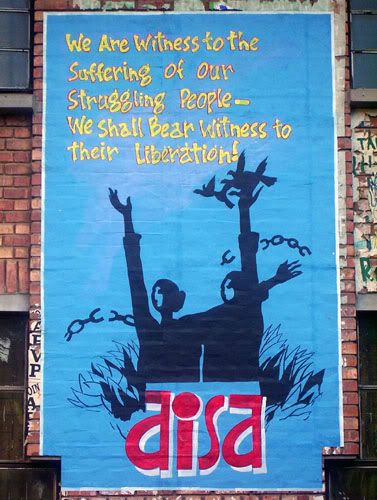
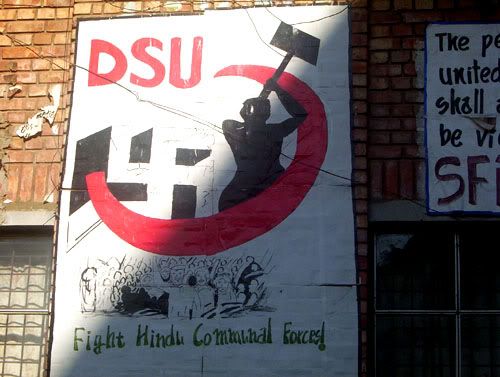
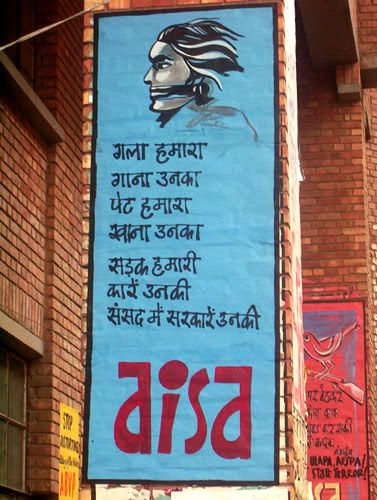
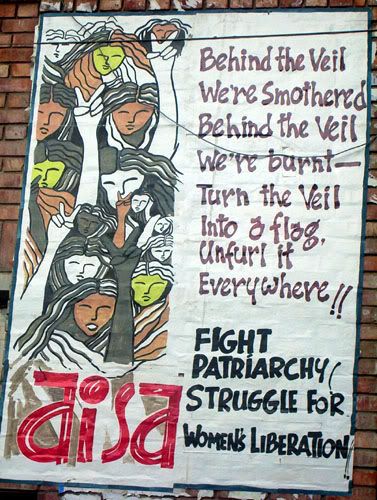
Political art

The various student political parties in JNU campaign by posting these massive posters all over campus. Most jut bear simple slogans, however there are the more artistic ones, done in a style that is possibly unique to the campus. Here are some that went up on the School of Language Studies building during admission time this year.

img
imgimg

The Mother and the Motherland

Apart for other things, one of the first points noticed about Indian men is our excessive usage of profanity, profanity that often employs references to women. Women see this as being indicative of our opinion as to their social standing. Think about it, the logic seems pretty sound, women are though of as being so lowly that most commonly used profanity centres around women.
Quite some time ago, when the whole ‘item number’ scene was rearing its ugly head and Mallika Sherawat had just emerged from the pool of Bollywood wannabes, I just happened to watch ‘The Big Fight” on NDTV. The issue being debated (or shouted about, as is often the case on that particular show) was something like the portrayal of women in media. The main portion of the show was devoted to the topic, however it did predictably spill over on to the status of women in society. Although there is much to be said on the issue, being a man and an Indian one in particular, I feel I wouldn’t be able to do justice to the issue, if you want to read more on it, read this post by
Erasmus-in-India in her Blog . Now back to the topic; one of the speakers, a woman, raised the point that even Indian profanity is directed at women. Erasmus-in-India agrees and writes;
“…I am not too astonished to find such an insult in the Hindi vocabulary. India is a male-dominated country where women are not always perceived at their fair value.”
I agree that Indian profanity is indicative of our perception of women, but I disagree with the conclusions they draw. The commonly held view is that women are seen as inferior and so are included in profanity and by associating a man with female genitals for instance, gives a particular word or phrase its negative connotation. Most people believe that the female genitals themselves have a negative connotation.
The way I see it is completely the opposite way, though my interpretation doesn’t do much to vindicate our perception of women either. Consider the most commonly used and most offensive insults used, they revolve around the Ma-Behen (mother and sister) system, they mainly involve referring to their genitals or sexual intercourse with a mother or sister. English has a corresponding insult for the latter but has nothing similar to the former. So why is calling an Indian man ‘Ma(or Behen) ki chut’ (mothers vagina) an insult? I don’t think it’s because of the negative connotation associated with the genitals alone, but rather holds a deeper meaning based on our role as an Indian man. Traditionally Indian men are expected to act as protectors and providers, women are seen as helpless dependants to be looked after. A man is expected to protect physically and safe-guard the dignity of the women he is responsible for, particularly his mother and sister. Thus referring to the genitals of a mans mother or sister gains additional significance as it crosses the line between insulting a man and insulting his masculinity by referring to those under his ‘protection’ in a negative light. A number of movies made in the 80’s and early 90’s highlighted this point, the worst a movie villian could do was to either kill the hero’s mother or rape his sister. As consequence inneumerable inconsolable heros hunted down and killed villians who had committed either (or in some cases both) of the crimes.
Women are seen as lesser humans, however there is no fundamental negative connotation associated with them as many allege. They are seen as property, something to protect against the world.
This is also why many men have no qualms against ‘eve-teasing’, women other than those you are responsible for are seen as some-elses property, something for which you bear no responibility and are thus free to treat as you see fit. Women are respected but not universally, we only extend our respect toward those under our control, all others are seen as fair game.
Our country, our motherland also receives such contradictory respect. Never talk badly about India in front of an Indian, there is a good chance you won’t live to describe it. This confuses a lot of foreigners who visit our country, they assume that people who litter the streets, have no respect for law and openly talk depreciatingly their own country wont really mind if they add their two cents worth. Most quickly realise how mistaken they are, the motherland like the mother is not to be discussed lightly. We draw a firm distinction between us and them, indians and non-indians and expect others to remember their place. To us India is never in the wrong, Indians are the greatest people and our mothers and sisters are temples of virtue.I’m not saying that we are right, but this is just the way we are.

Thursday, August 10, 2006

A Tit, a Clit and an Elephant Dick Do Not Necessarily Equal Wholesome Family Fun

Apparently though that is what one Pushpa Vitula had assumed when she attended a now infamous exhibit.
The moral police ensured that an art exhibition, explicitly titled ‘Tits, Clits n Elephant Dicks’, did not go on uninterrupted in Mumbai on Saturday.
Following an obscenity complaint by a woman named Pushpa Vitula at the Colaba police station, 12 policemen stormed the exhibition showcasing the works of Sanjeev Khandekar and Vaishali Narkar at the Jehangir Art Gallery and took pictures of the exhibits for evaluation.
Read the full report at DNA Mumbai

This whole issue is stupid at so many levels that I don’t know where to begin. Lets start right at the beginning. Ms. Pushpa Vitula decides to attend an art exhibit titled ‘Tits, Clits n Elephant Dicks’, the organizers have done a good job here. The title explicitly describes what you can/cannot expect inside, for instance, looking at the title one would not expect paintings of the Virgin Mary or any renditions of other ‘virtuous’ and chaste subjects. Undeterred by this warning, Ms. Pushpa Vitula our bold adventurer pressed on and thus in my opinion gave her consent to view any content displayed.
Lawyer Mahesh Jethmalani says: “…The lady, who found the exhibition obscene, went to view it out of free will. If she was offended, she had the choice to walk out. There is no question of conflicting rights or enforcing the law here.”
Source:DNA Mumbai
Now we jump forward in time to later that ill-fated day. Offended by the exhibit, she decides to go on record with her protest and runs to the friendly neighbourhood police station and registers a complaint. I can’t begin to fathom her motive(s) for doing so, maybe she thought she needed protection from the evil ways of the morally corrupt artists, I think she would have done better to go to a temple. I personally feel those who see obscenity in everything around them are fundamentally perverts themselves. Especially in the case of art where there are a number of perspectives to choose from, people tend to go with the one most reflective of their own views. Perverts can only see obscenity because that is all they are looking for. Now I’m not saying that our intrepid explorer, Ms. Pushpa Vitula is a pervert, but she doesn’t leave much room to allow for other possibilities.
Then we come to the police the self-appointed defenders of Indian morality, they made two inexcusable errors, first, actually entertaining such a complaint and finding sufficient cause to turn up at the exhibit and then by actually confiscating some pieces for ‘evaluation’. Evaluation? Am I supposed to conclude that along-with the forensic department, the police now have an art appreciation wing? What were they attempting to evaluate? From their confiscation the pieces and recording of the entire exhibit on video as evidence, it becomes clear the police have whole-heartedly embraced their role as guardians of morality.
What we have here is not just a case of a daft woman making a dumb complaint; there is a more disturbing aspect, the fact that the police seem willing to abandon their duties to the maintenance of law and order in favour of moral policing. The question is whose morals do they want us to live by? I suspect that they would lean toward the principles held by those like our protagonist Ms. Pushpa Vitula, a prospect that I fear as much as they would if they had to live by my morals and principles.
Again I have to fall back on the essential freedoms guaranteed to us in the constitution, it’s amazing how many times we have to remind ourselves of them. For an ‘allegedly’ democratic country we are unusually obsessed with censorship and show an uncomfortable tendency toward totalitarianism.

“Anyone who considers this obscene must have had their first orgasm here.”
Art dealer and collector Ashish Balram Nagpal Source:DNA Mumbai

Monday, August 07, 2006

For The Conscientious Watch-dog

Every society has them, they are the unavoidable consequence of living in a group, they take unto themselves all the ills of society and protect us form ourselves. The watchdogs, from the sleaze on our streets to the corrupting influence of media, they vociferously oppose everything. In a democratic society, I suppose they are necessary, especially in India, where someone has to keep an eye on our government, which acts more for its own benefit than for that of the people. Today however, the watch-dogs have spawned into a veritable industry, protesting and opposing almost everything done in the country. Everyone with control issues seems to be on-board lending their voice. Some consider themselves the protectors of Indian morality and culture while others are busy saving us from the designs of the evil capitalist industrialists. It is with the latter whom we will concern ourselves today.
These particular watch-dogs are intent on protecting us from any big industry, particularly multinational companies or as we refer to lovingly as; MNCs. Some of the MNCs’ on the most wanted list are Coke, Pepsi and not surprisingly Monsanto. One group that has taken upon itself to attack all three is the Centre for Science and Environment. The CSEs’ latest attack has been on the cola giants, alleging (again) that there are traces of pesticides in their products. The CSE and other Indian NGOs hold a deep-seated grudge against the two and have raised a number of serious issues against them including the pesticide issue as well as exploitation of groundwater resources in the vicinity of their bottling plants. So far so good but I just cant help be suspicious of their actual motives, sometimes I just get the feeling that all organizations involved enjoy kicking up a storm just for the sake of a little additional publicity rather than for actually doing any good. Pepsi and Coke (particularly Coke) have been at the centre of much public debate concerning their adverse health effect, on how they are very effective at cleaning out toilets or can dissolve teeth in a few hours. Banning their sale from schools and other public places has become an accepted method of gaining a little attention or political mileage. I do not question the obvious health benefits of limiting the sale of colas but I have begun to doubt the motives of those pushing for the same.
In a recent public debate hosted by a prominent Indian news channel, the representatives for the CSE and the Cola manufacturers argued it out in fine Indian style. What struck me was the incoherence of the lady representing the CSE. She kept coming back to one point that Pepsi and Coke were just luxury items with no obvious health benefits and should hence be banned, she quoted how toxic the pesticides that were allegedly found in them are and waxed eloquent on how they were exploiting the resources of the country for their own profit. I had a problem with most of what she said. First (as the host also pointed out), there are many so-called luxury products with no obvious benefits (often with associated health hazards) that are openly sold in the country. Alcohol being at the foremost of such a list were one ever compiled. Alcohol poses a definite health risk in addition to all the allied social problems it causes. Prohibition is the only true solution to alcohol abuse, but we all know how well that works. A number of state governments have tried it at one point or the other but neither the government nor the law survived for long. Second, if pesticides are in the ground water being used for the manufacture of colas, then I think it would be safe to assume that those very pesticides would be present in the water being consumed by millions of Indians, along with a number of other undesirable contaminants possibly in higher quantities than in the drinks. If everyone is really so concerned about consuming pesticides then they should be a little proactive in reducing their use. A simple alternative would be to use GM crops that require less pesticide use, oh but I forgot, Monsanto is also on their most-wanted list, so we can’t really have that right? So what do we do, just ban Pepsi and Coke, sit back and pat ourselves on the back for having thwarted their evil plans? That would seem to be the Indian way to do it, win a battle at the cost of the war. We tend to be shortsighted in most of our endeavours and that’s why more often than not they fall flat on their face. If Coke contains pesticides then I’m pretty damn sure every restaurant in the country is also serving water that is full of DDT, BHC and a plethora of other bug-killers. Try shut them all down, I dare you, I double-dare you. I have a feeling Coke and Pepsi are just being targeted because they are soft targets, public opinion is against them (a contradiction if you consider their enormous sales) and any attack against them is sure to gain a lot of media attention, in a sense they are being victimised.
One common thread running through most watch-dogs is their tendency to use the ‘B’ word. They seem to want to ban everything, it was scary at first but now it’s just grown irritating. I do not like their holier-than-thou attitude and I resent being told what I can and cannot do. A fundamental feature of democracy is the freedom to do what the fuck you want to do to yourself. You may advise me to do or not do something and it is my prerogative to listen to or ignore you, but I resent and oppose anyone telling me what I may or may not do. All these NGOs and other watch-dogs seem to believe that we Indians are essentially a stupid people and do not know what is good for us. What they all try to do is to make enough noise to enforce their will over the entire population. They seem to think that they are our elected representatives. The reason that there is little opposition to what they are doing is because in India there isn’t any concept of freedom of choice, we are so used to being ordered around by our families and by everyone else elder than us, we don’t really resent it when just about anyone else does it to us. Another important factor is that watch-dogs only pursue issues which allow them to hold the moral high ground, as in this case, to oppose them would be to side with the evil Cola giants. Faced with such a situation, how many people would really raise their voices against the power hungry NGOs?
Lastly I would like to say something about the NGOs themselves. NGO stands for Non Governmental Organisation, they are technically not intended to earn profit but that hasn’t stopped anyone associated with them from earning a damn good living off them. They are no longer seen as crusaders for a better India but as an opportunity to earn a fine living. They are fundamentally corrupt and I wouldn’t trust them to weed my garden much less influence national policy. I have no problem with those actually doing good quietly like working with street children, educating women and suchlike. So while I sip my rum and coke and smoke my cigarette I have but one message for the rest, “go find yourselves a real, honest job.”

Saturday, August 05, 2006

The Various Guises of Musical Snobbery

It was amazing, after two years in a new school, meeting my old friends freaked me out. People who’d been teeny-bopping to Britney, BSB et al. were now sophisticated–hippies.
Yes sophisticated-hippies, there is such a thing, here’s how you make one; throw a few CDs of Jeffersen Airplane, The Doors, Janis Joplin, CCR, Led Zep and Hendrix together, throw on a Khadi-Kurta, a pair of strategically ripped jeans, roll some weed in a Rizla and light up. Yeah they were sophisticated as hell, they were fucking high-society, prim and propah motherfuckers I half expected them to pronounce their ‘aitches’. They hit all the popular clubs spoke depreciatingly about GnR, Metellica and Maiden and debated spirituality. They were only hippies as far as their sweet –smokes and free-love, but they intimidated the shit out of me at the time. I was then in the throes of full-blown adolescent-non-conformism, listening to Papa Roach and Linkin Park and just anyone else crying about adolescent angst. I’d been too busy piercing various projections on my face to take notice of their retro-metamorphosis and now I couldn’t get over the transformation, I’d left them Friends-watchers and they were now the Khadi-Brigade
What ticked me off was that they were now preaching to me about the music I’d grown up on. Suddenly Sgt. Peppers’, A Hard Days Night and Help were no longer adequate, I needed to know a whole list of Lennons’ individual ventures in order to be considered a true fan and not the freak-bastard that I was. What pissed me off the most was that the Stones were not on their list of music considered cool enough. I think the Stones suffered in popularity with the KBs because they just weren’t intense enough, the acid didn’t show in their music, they were having too much fun doing what they did and there wasn’t enough depth to their songs. One alleged Mick Jagger imitator; Steven Tyler faced similar treatment from the Metal-Heads, Aerosmith fell short in the critical ‘hardness quotient,’ Slayer, Pantera and Metallica being the accepted standards. Aerosmith, the poor buggers were not hard enough for the Metal-Heads, not polished enough for the Teeny-Boppers, not gangsta enough for the Home-Boys and not nearly dead enough for the Khadi-Brigade and they suffered in popularity for their indecisiveness.
I have been cursed with (and for) an eclectic taste in music, I love Travis but am equally enamoured with Cradle of Filth, I like Metallica but think Pantera is a pain in the ass, hell, I loved Vivaldis’ Four Seasons. I snigger at people who call into request shows on radio and TV and say they like rock and then request Bryan Adams or Bon Jovi; I am very protective of my definitions of musical genres. In people like me this gives rise to another form of musical snobbery, for us the only good music is what we listen to, we lack unity because we seldom agree on what good music is, we are the discordant biblical inhabitants of a musical Babel.